|
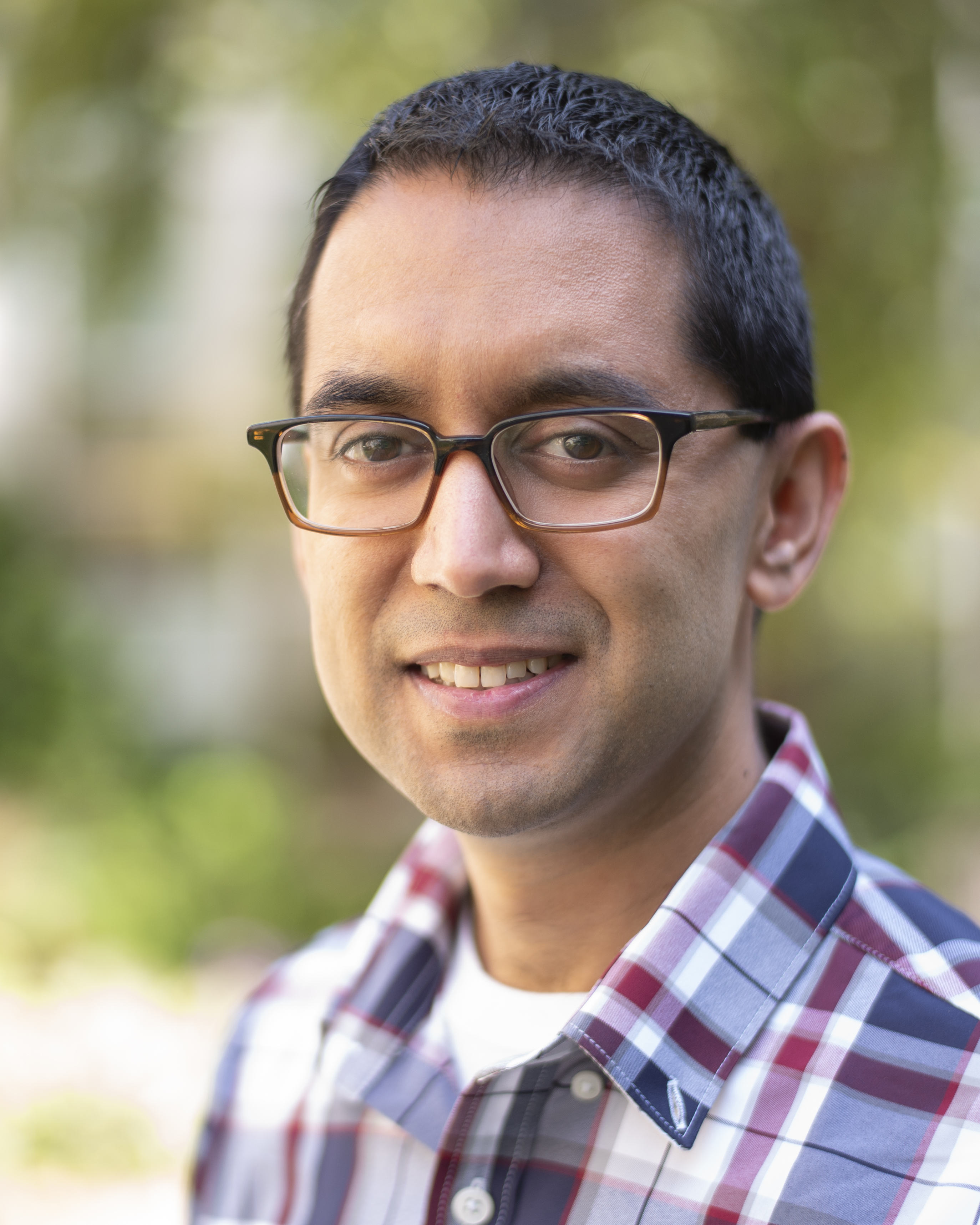
Ameet SoniAssociate ProfessorComputer Science Department Swarthmore College phone: (610) 957-6288 office: 232 Martin Hall email: asoni1 (at) swarthmore dot edu |
|
|
Ameet SoniAssociate ProfessorComputer Science Department Swarthmore College phone: (610) 957-6288 office: 232 Martin Hall email: asoni1 (at) swarthmore dot edu |
| Fall 2026 Schedule | ||
| CPSC 19/PHIL 27: Ethics and Technology | 1:15pm-2:30pm Tue, Thur | 300 Martin Hall |
| CPSC 63: Artificial Intelligence (Lab C) | 2:45pm-4:15pm Tuesday | 313 Martin Hall |
| Office Hours | Wednesdays, 3:30pm-4:30pm; Fridays, 10:00am-11:00am, and by appointment | 232 Martin Hall |
Probabilistic Modeling for Complex Systems: My lab develops probabilistic frameworks to model uncertainty in complex biological and clinical systems. Key projects include utilizing conditional random fields for brain tissue segmentation, building causal models for dementia research in rural populations, and applying advanced probabilistic inference methods - such as belief propagation and particle filtering - to determine 3D protein structures
Clinical Diagnosis and Decision Support: We apply machine learning algorithms to improve disease diagnosis and guide clinical decision-making. Recent work includes developing causal models for understanding dementia in rural populations, imitation learning for pediatric clinical support, as well as utilizing deep learning and functional gradient boosting to identify Alzheimer’s and Parkinson’s diseases.
Medical and Biological Image Analysis: To extract insights from complex, noisy, and limited image data sets, we develop algorithmic approaches for diverse imaging modalities. Our projects span many problems including diagnosing Alzheimer's Disease based on 3D MRI, determining protein structures via X-ray crystallography, analyzing planarian behaviour from video tracking, diagnosing several maladies simultaneously from chest X-rays, and segmenting plant roots from fluorescent expression videos. Methodologically, we leverage a variety of approaches including Markov random fields, conditional random fields, convolutional neural networks, and computer vision segmentation.
Statistical Relational Learning: Real world data is inherently noisy and interconnected, presenting challenges for traditional machine learning frameworks. In collaboration with Prof. Sriraam Natarajan (UT Dallas), we utilize approaches such as Relational Dependency Networks to model these complex dependencies. Applications include relational text extraction and diagnosis of Parkinson's disease from medical records.
CS Education and AI Ethics: In addition to technical research, we study computer science pedagogy and the societal impacts of technology. This work includes evaluating interventions to improve student retention in introductory CS courses as well as developing curricula for teaching AI ethics. Recently, in collaboration with Prof. Tia Newhall, we have developed a miniature database system (SwatDB) to teach core architecture concepts for DBMS courses.
Asterick's (*) indicate supervised students.
A Neurosymbolic Approach for Explainable Early Diagnosis of Alzheimer's Disease.
.
In 20th International Conference on Neurosymbolic Learning and Reasoning (NeSy), 2026. Forthcoming
Causal Models with Tiny Data: The Case of Rural People Living with Dementia.
.
In Artificial Intelligence in Medicine (AIME), 2026. [slides]
Imitation Learning for Clinical Decision Support in Pediatric ECMO.
.
In Artificial Intelligence in Medicine (AIME), 2026. [poster]
A Module for Introducing Ethics in AI: Detecting Bias in Language Models.
.
In Proceedings of the 10th Symposium on Educational Advances in Artificial Intelligence (EAAI), 2020. [slides]
Dugesia japonica is the best suited of three planarian species for high-throughput toxicology screening.
.
In Chemosphere, vol. 253, pp. 126718, 2020. [cached]
Deep Residual Nets for Improved Alzheimer’s Diagnosis.
.
In Proceedings of the 8th ACM Conference on Bioinformatics, Computational Biology and Health Informatics (ACM-BCB), 2017. [poster]
Identifying Parkinson’s Patients: A Functional Gradient Boosting Approach.
.
In Artificial Intelligence in Medicine (AIME), 2017.
Learning relational dependency networks for relation extraction.
.
In Proceedings of the 26th International Conference on Inductive Logic Programming (ILP), 2016. [slides]
A Comparison of weak supervision methods for knowledge base construction.
.
In 5th Workshop on Automated Knowledge Base Construction (AKBC) at NAACL, 2016. [poster]
A comprehensive analysis of classification algorithms for cancer prediction from gene expression.
.
In Proceedings of the 6th ACM Conference on Bioinformatics, Computational Biology and Health Informatics (ACM-BCB), pp. 525–526, 2015. [poster]
A support program for introductory CS courses that improves student performance and retains students from underrepresented groups.
.
In Proceedings of the 45th ACM Technical Symposium on Computer Science Education (SIGCSE), pp. 433–438, 2014.
A graphical model approach to ATLAS-free mining of MRI images.
.
In Proceedings of the 2014 SIAM International Conference on Data Mining (SDM), pp. 974–982, 2014. [poster]
Probabilistic ensembles for improved inference in protein-structure determination.
.
In Proceedings of the 2nd ACM Conference on Bioinformatics, Computational Biology and Biomedicine (ACM-BCB), pp. 264–273, 2011. Invited for journal publication. [slides] [cached]
Guiding belief propagation using domain knowledge for protein-structure determination.
.
In Proceedings of the First ACM International Conference on Bioinformatics and Computational Biology (ACM-BCB), pp. 285–294, 2010. Best Paper Award. [slides] [cached]
Creating protein models from electron-density maps using particle-filtering methods.
.
In Bioinformatics, Oxford Univ Press, vol. 23, no. 21, pp. 2851–2858, 2007. PMCID: PMC2567142
Improved methods for template-matching in electron-density maps using spherical harmonics.
.
In IEEE International Conference on Bioinformatics and Biomedicine (BIBM), pp. 258–265, 2007. Invited for journal publication. [code/data]