As a part of our project we distributed a survey to a randomly selected group of students. The survey contained questions about general socioeconomic background, computer history, current computer usage and finally a series of professionally generated questions meant to assess relative levels of depression and social anxiety. The data from the 35 completed surveys are available - contact Joshua Kramer.We then ran a number of regressions on the available data, and came to some interesting conclusions. The first regression we ran was a direct regression on computing time vs. depression and anxiety. We found that with 99% certainty, the more hours one spent on a computer correlated positively with ones depression scale, and found that with 88% certainty that the correlation between anxiety and hours spent computing was positive.
We then created composite variables to estimate time spent playing games (which was the 0-3 rating given to game playing, times the hours spent playing games, divided by the sum of all ratings) and the ratio of game playing to other activities and found that the more time an individual spent playing games was not statistically significant to their depression levels and that the ratio of game playing time to other computer time was negatively correlated with depression levels at a 69% degree of certainty.
We did the same analysis for other computer usages with significant returns and found that spending time writing papers was, with 98% certainty, correlated with depression, while the ratio of paper time to other computer usage time was, with 81% certainty, inversely correlated with depression, meaning that the more time students spent writing papers, the more depressed they were, but that this was ameliorated by other computer usage.
Correcting for socioeconomic characteristics (including race, income levels, sex and class year in the regressions), the hours correlation is positive with 89% certainty, neither the games time nor rate had statistically significant effect. Inside the socioeconomic characteristics, both class year and income had significant effects, with 94, and 84 percent certainty, respectively.
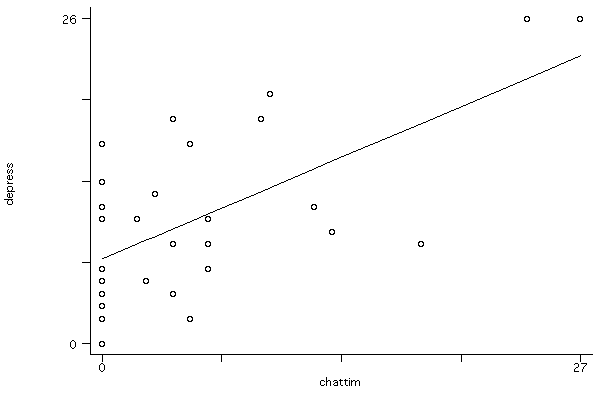
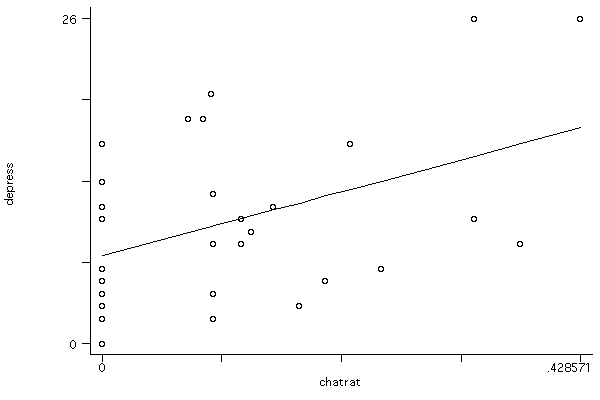
The most significant effect, however, with 99.8% certainty in the socioeconomic corrected regression were the chat variables - chat time (chattim in hours) and chat rate (chatrat as a ratio to total time spent on the computer), with huge positive depression effects. Graphs of their uncorrected effect follow - the corrected effects have far less variability. From this, we have concluded either that people who are depressed use computers to look for company or that the communities available online cause depression in people.
To determine which of these were more relevant, we separated the population into two groups - heavy chatters with significant computer experience as measured by the sum of question K and heavy chatters with less experience. We found that experienced heavy chatters (individuals who had regularly used computers since before college and also chatted more than one hour a day) had depression not significantly different than non-experienced heavy chatters, so we have been led to tentatively conclude that online communications both draw depressed people to them and increase the depression of their users. Certainly, cohort studies are required to more adequately determine this effect.
To summarize:
- The number of hours spent on computers correlated positively with respondents' depression and anxiety levels; the more time students spent using computers, the more depressed they were.
- We may say that for a constant amount of computer usage, greater computer game playing time has at best only the weakest of correlations with depression.
- Doing work such as writing papers on computers was associated with greater depression, but this depression was relieved by other activities in front of the computer.
- Time spent chatting and the ratio of computer time used to chat correlated positively with depression remarkably. Two conclusions might be drawn:
- lesser social interaction increases depression and drives users to chat more, or
- chatting decreases social interaction and therefore expedites the onset of depression