CS21:Intro to Computer Science (Griffin/S13)
Academic Integrity | Academic Accommodations | Links
Announcements
- Fri May 10th 1-4pm, Jean and Jeff will be in the lab to answer questions.
- Final exam is Sat May 11 at 2pm, Sci Center 101
Class Info
Section 2: TR 9:55–11:10, Sci Cntr 240Section 1: TR 11:20–12:35, Sci Cntr 240
Professor: Jean Griffin
email: griffin at cs.swarthmore.edu
Office: Science Center 249
Phone: 610-690-5700
Office hours: Monday 1:00-2:30, Look for me in Science Center 249 (or 240)
Other Sections:
Richard Wicentowski (MWF 10:30–11:20am)
Jeff Knerr (MWF 11:30–12:20pm)
Welcome to CS21. This course will introduce fundamental ideas in computer science while also teaching you how to write computer programs. We will study algorithms for solving problems and implement solutions in the Python programming language. Python is an interpreted language that is known for its ease of use. We also introduce object-oriented programming and data structures. A deeper coverage of these topics will be presented in CS35.
This course is appropriate for all students who want to learn how to write computer programs and think like computer scientists. It is the usual first course for computer science majors and minors. Students with advanced placement credit or extensive programming experience should place out of this course and instead begin with CS33 (or CS31) or CS35.
Required Textbook:
ISBN: 978-1-887902-99-1
(a copy is on reserve at Cornell Library)
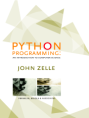
Goals for the course:
By the end of the course, we hope that you will have developed the following skills:
- Given a program, be able to simulate on paper how a computer would execute the program, and show the results that would be produced.
- Given a problem, be able to design a clear, concise, and correct pseudo-code algorithm to solve it.
- Given a pseudo-code algorithm, be able to successfully implement it in Python.
- Be able to use top-down design to sub-divide a large problem into reasonably-sized modular sub-problems.
- Given several algorithms for solving the same problem, be able to analyze which algorithm would be more efficient in terms of running time.
- Develop debugging and unit testing skills. Consistently use these skills while implementing programs.
- Learn to work as part of a team to solve problems starting from design and continuing through to implementation.